Article
Personalization's Identity Crisis
Users deserve more for their data — designing personalized experiences that go far beyond greetings and recommended carousels.

Back to Articles


Have you ever logged into another user’s Netflix account and felt completely lost? The core components are consistent from person to person, but the content dynamically generated for each individual is disconcerting. From the items that appear to the order in which they are presented, your personalized view feels natural and comfortable, handpicked just for your tastes. But of course it isn’t curated, it’s algorithmically generated; no single product owner can truly anticipate exactly what you’re seeing.
In order to design a bespoke experience for each user on every visit, you must abandon the notion that you can control exactly what that user sees and how they interact with it. Surrendering control by creating adaptive systems and mechanisms that allow users to influence their unique experience is the key to designing a platform that feels highly personal. By leveraging key insights and smart design decisions, you too can deliver effective one-to-one personalization. I’ll show you how.
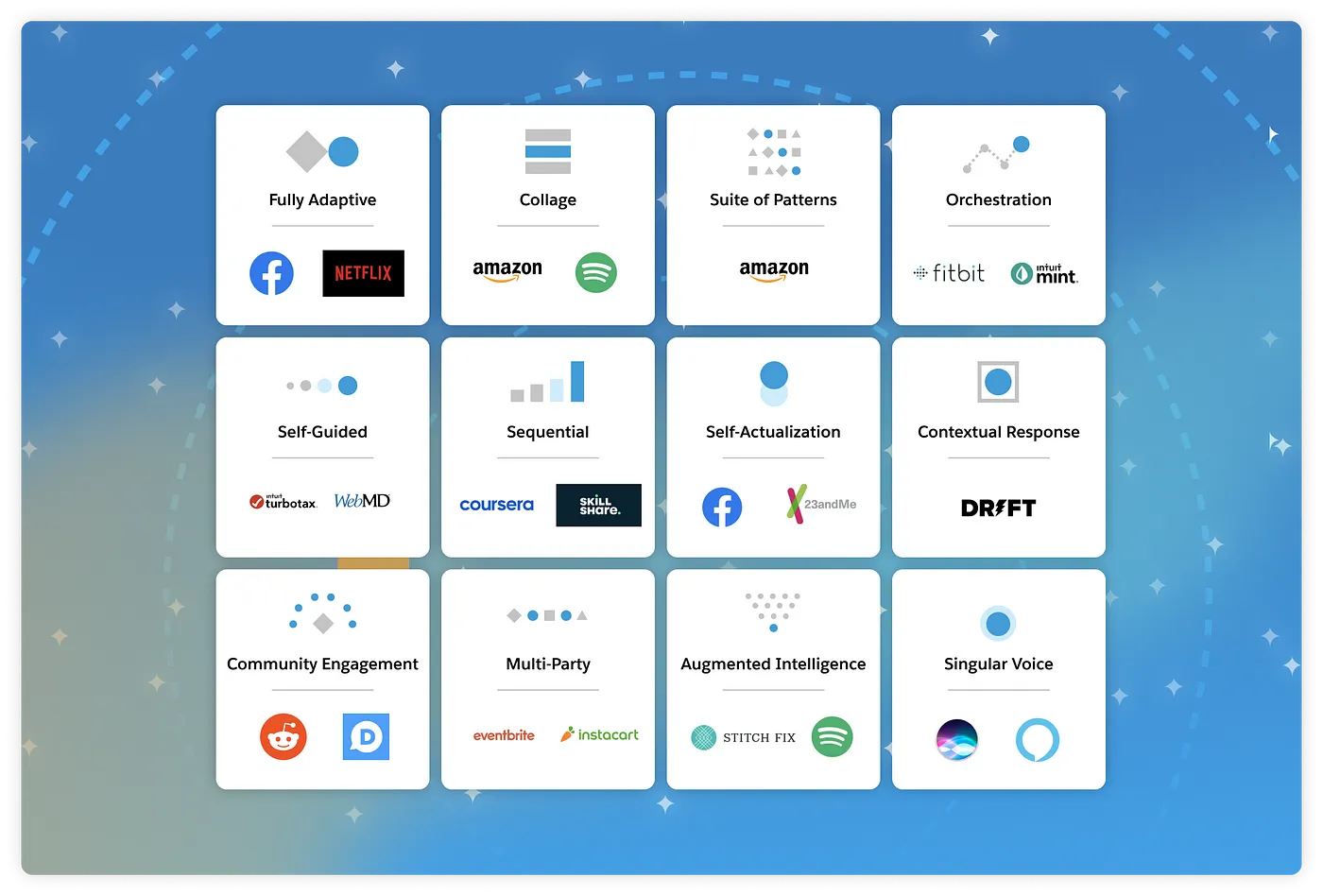
As argodesign explored a new vision for Salesforce.com late last year, we realized that most everyone’s concept of personalization is surprisingly limited. Far more than a mechanism for named greetings and related reading, intelligent personalization can be leveraged to guide users across their brand journey, redefine how they discover and engage with content, shape conversations and connections, and provide unparalleled intelligent support. To craft an effective strategy, our team would need to rethink how we designed content in order to expand our stakeholders’ worldview on the wonderful possibilities for this technology.
Many designers assume personalization is all about prediction, but it’s much simpler than that. As we discovered through an immersive ethnographic study we conducted for a major daily newspaper years ago, the foundation for a successful strategy actually starts with reflection; more fundamental than knowing a user is understanding how a user wants to be known.
Requisite to enabling deep personalization is designing mechanics for your users to express themselves. Serve first, then sell; allow users to curate their own experience, empower them to self-organize both content and communities, observe, and learn. Only then can you anticipate their desires.
Successful platform products understand this intimately; inspired by brands like Facebook and Spotify we designed a highly personal start page called MySalesforce. This new area of the website provided individuals with tools to save, organize, and share their favorite content, centralize personal tasks and communications, describe and refine their profile and interests, and reflect on their unique relationship with the brand. These powerful platform components require no algorithms, but form the basis for building rich and complete data profiles across your user base.

When most people think of personalization they imagine recommended content carousels that promote items of interest to each visitor. But even executing that basic design effectively is not so simple. What does “Recommended for You” even mean? Recommended right now or forever? On this page only, or everywhere on the site? Will it change with my behavior or mood? Can such a catch-all term truly encapsulate a user’s intent in any given context?
Of course it can’t, not with any accuracy. As designers we often gloss over copy, ‘lorem-ipsum’ing our way through layouts and user flows that broadly capture a customer’s experience. But personalization requires us to think deeply about the material displayed on each page component.
Amazon and Netflix perfectly illustrate this notion. Each page is supported by not just one but a multitude of recommended content carousels, creating a collage of contextually appropriate items for users across topics, interests, categories, and behaviors. “New This Week,” “Because You Watched,” “Frequently Bought Together,” and “Similar Items to Compare,” are more precise components that, used together across an experience, help users discover and engage with content specific to their current mood and intent.
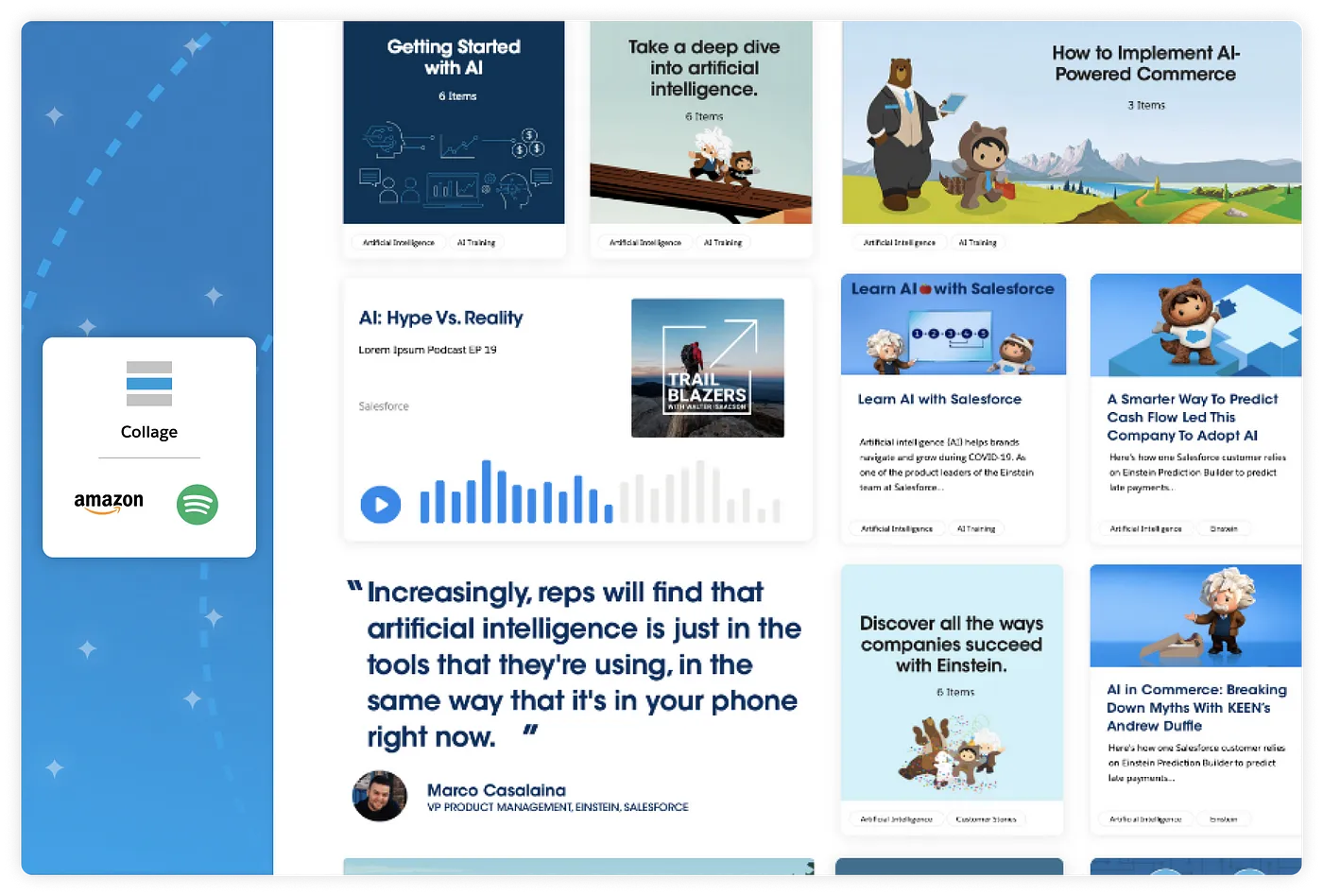
This realization changed how we worked with content owners and delivered design documentation for Salesforce. For each component, we detailed the library of objects represented and the personal, contextual, and behavioral factors that defined an item’s display, ranking, order, and description. (My favorite is called the wedding mix — “something old, something new, something borrowed, and something blue,” — representing a carousel that presents a blend of previously read, recently added, trending, and wildcard content to deliver fresh, dynamic finds on a recurring basis.) Along with the pattern playbook, this resource helped our teams quickly describe the desired dynamic content which drives personalization across the platform.

To take things a step further, you need to consider the various intentions of a user on each page and every visit, and the role content plays in satisfying their needs. Typical user flows are an exercise in content reduction — how do we employ tools such as search, filters, and navigation to help users find the exact thing they are looking for? Designing for content is more often an exercise in discovery and exploration — how do we create mechanisms that present users with a never-ending supply of inspiring new material on each refresh?
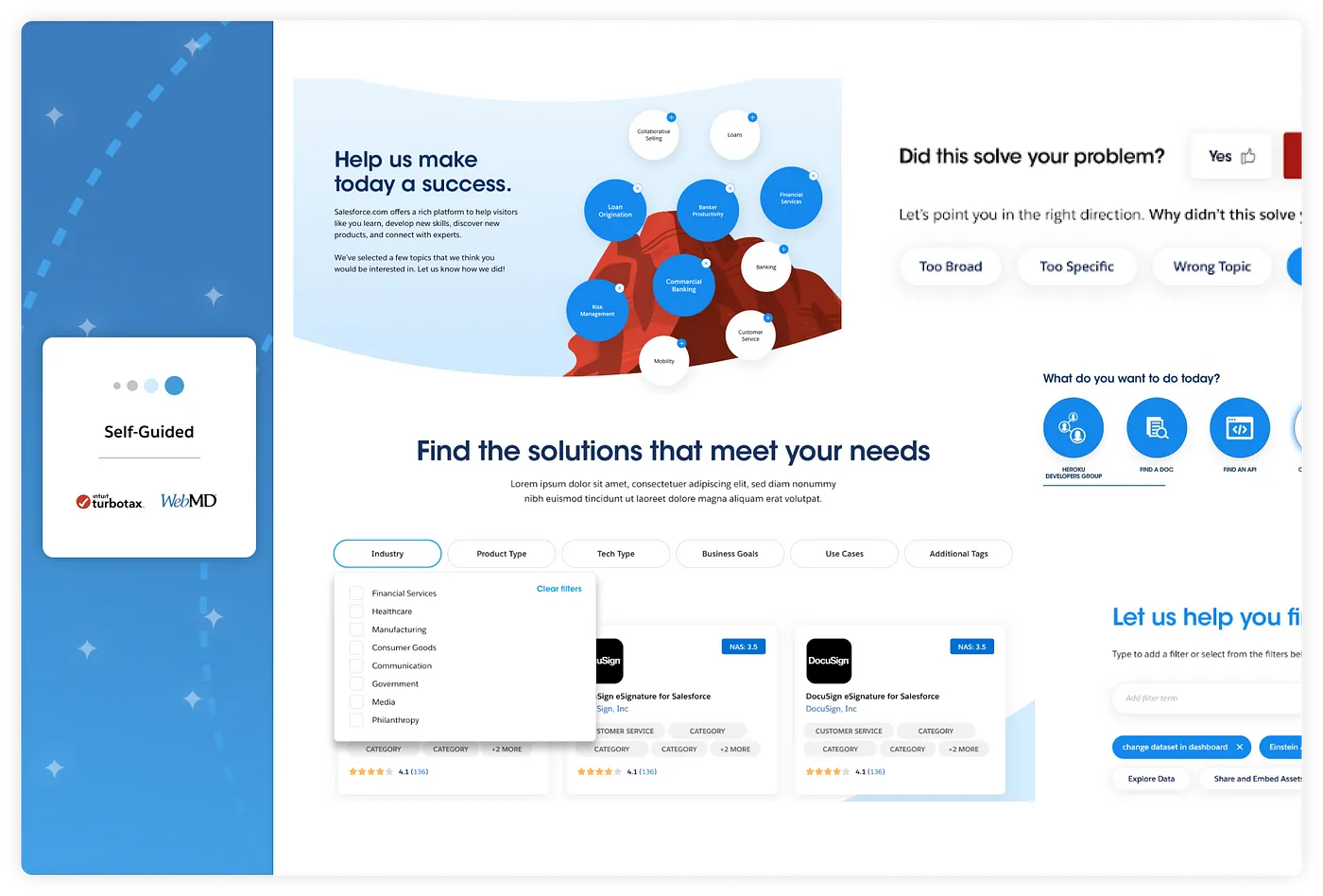
For Salesforce, our team was able to exercise a multitude of personalization components. Leveraging over 50 distinct patterns used by more than 30 brands, we designed articles that oriented readers, encouraged and engaged social interaction, delivered key media content, and guided next steps and exploration. Multi-vector carousels and collages inspired by Amazon helped to generate never-ending engagement loops within editorial pages, driving users into deep topical research and content collecting. Reading queues and infinitely scrolling feeds pioneered by Facebook and Medium encouraged active consumption over hunting and gathering, and complemented highly-personal pages to deliver mixed network activity and recommendations. Playlists, collections, and curricula like those featured on Spotify and Coursera served as the building blocks for learning and personal development across multiple visits, and symptom checkers and guided configurators similar to WebMD or TurboTax formed the basis for designing a self-service support center for the brand.

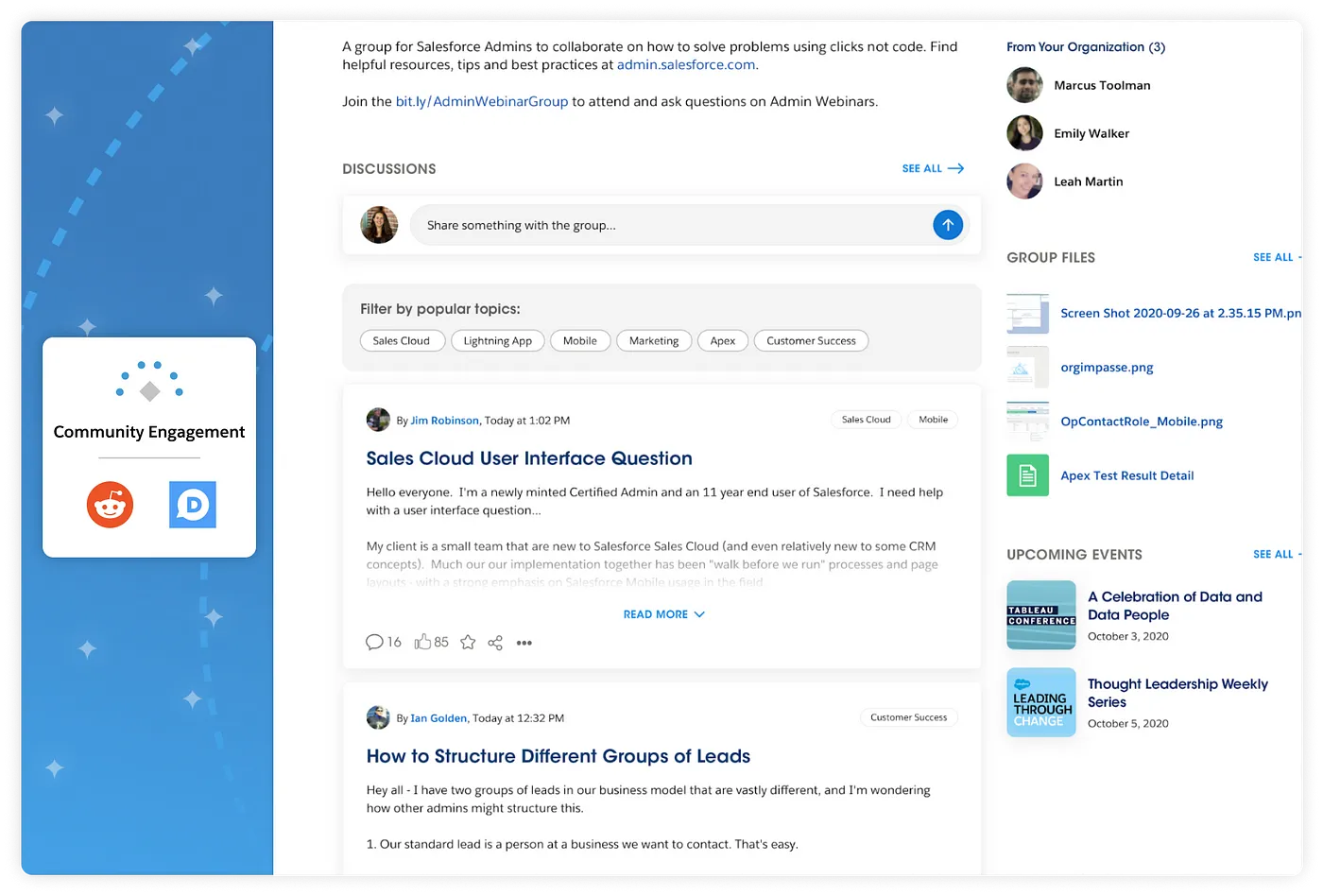
The content a user sees each visit isn’t determined solely by the publisher and the individual; it’s also affected by crowd wisdom. Publishing for personalization does not omit community. Media is inherently social; users self-sort into cohorts, tribes, and personas, and seek out timely and relevant content that resonates with that group identity. Timely means trending, and relevant means popular; as anyone remotely aware of social media can attest to, both factors are nigh impossible to predict with accuracy.
Our advice for Salesforce was thus to embrace and expand that community voice, extending social interactions and community conversations throughout the website and encouraging users to contribute, react to, rank, and share their experiences with the broader user base. The platform strategy we designed utilized both audience-heavy components similar to Reddit and individually weighted algorithms popularized by Facebook. Both models played a role in creating a balanced, bespoke environment for content creation and consumption.
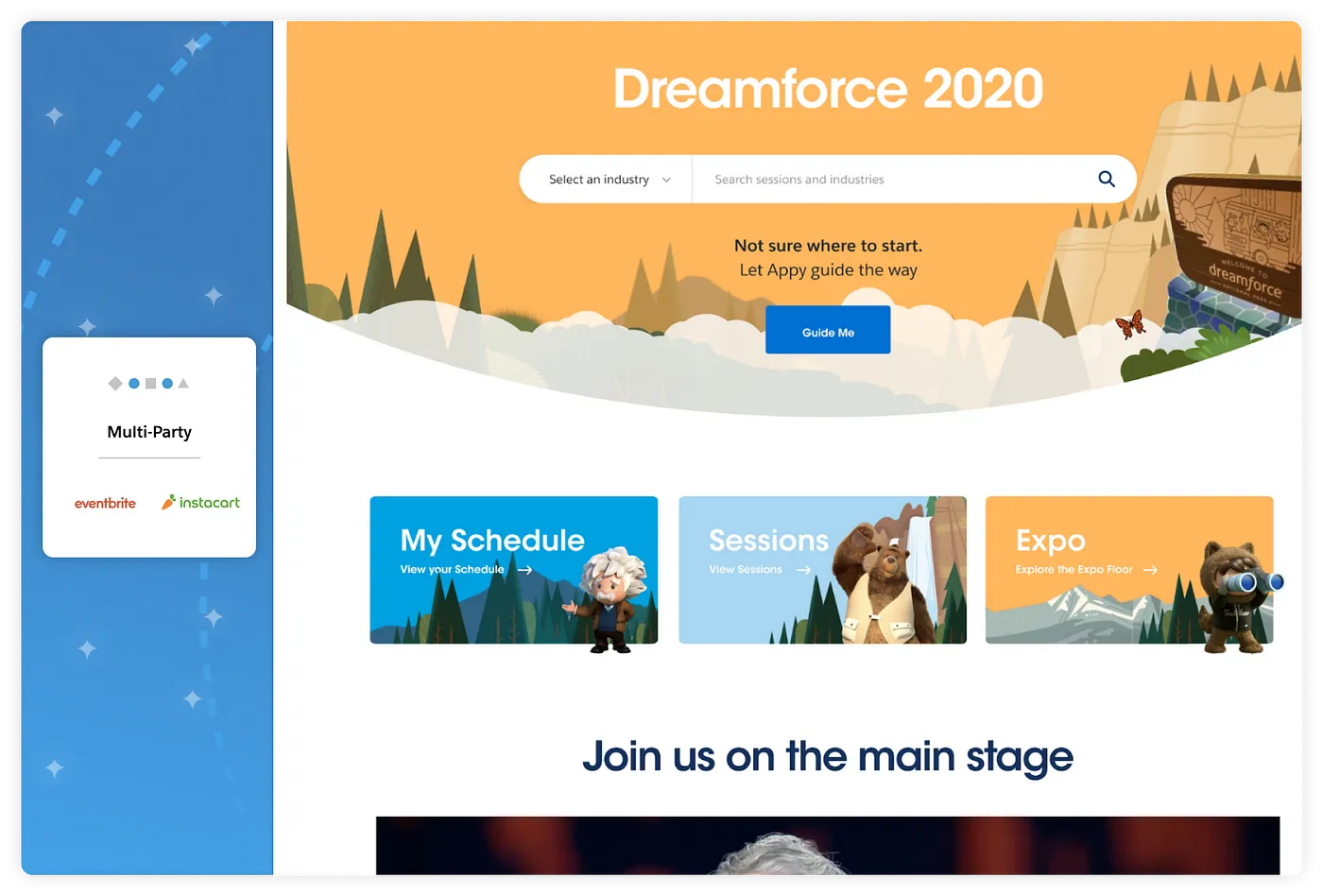
While social and discovery patterns support engagement, there’s another missing element for a fully-personalized platform. True adaptability requires that the product grows with each user, and in turn supports a user’s growth through repeated use.
Mastery, whether topical or product use, requires a prescribed curriculum of content meted out over multiple sessions. We designed personalized components which enable users to develop knowledge and skills through instruction, practice, and repetition throughout every interaction on the platform. Going beyond prescribed courses in Learning, the personalization patterns pull in relevant events, thought leadership, community posts, and product tutorials to continually reinforce new skill development. Furthermore, pages and components throughout the website evolve and transform with the user as they become more familiar and proficient with the product. For this, we designed an orbital framework that remixes page components based on a user’s score along key metrics, including topic mastery, engagement, and brand affinity. Pages shift as visitors move from distant to near orbit before launching learners into adjacent topics and communities. Individuals can literally track their progress through the UI, reflect on what they’ve learned, and receive feedback and advice to explore new personal and professional challenges.

The last piece of advice is simple but potentially transformative: pull back the curtain, unveil your insights, and give your users a mirror to understand, adjust, and revisit their activity and accomplishments. Rich, detailed histories can offer users a convenient way to recall important details and reminisce on key moments, offering both utility and perspective on an individual’s evolution over time. In the case of Spotify Wrapped or Fitbit, this pattern can help users find belonging and better understand themselves. It can also be an invaluable reference for investigation and troubleshooting.
For Salesforce, we designed pages that allowed users unfettered access to their activity history and a visualization of their interest graph. We also created a homepage component to succinctly surface content from yesterday alongside prompts for today and tomorrow (read as continue reading, reminders, and upcoming).
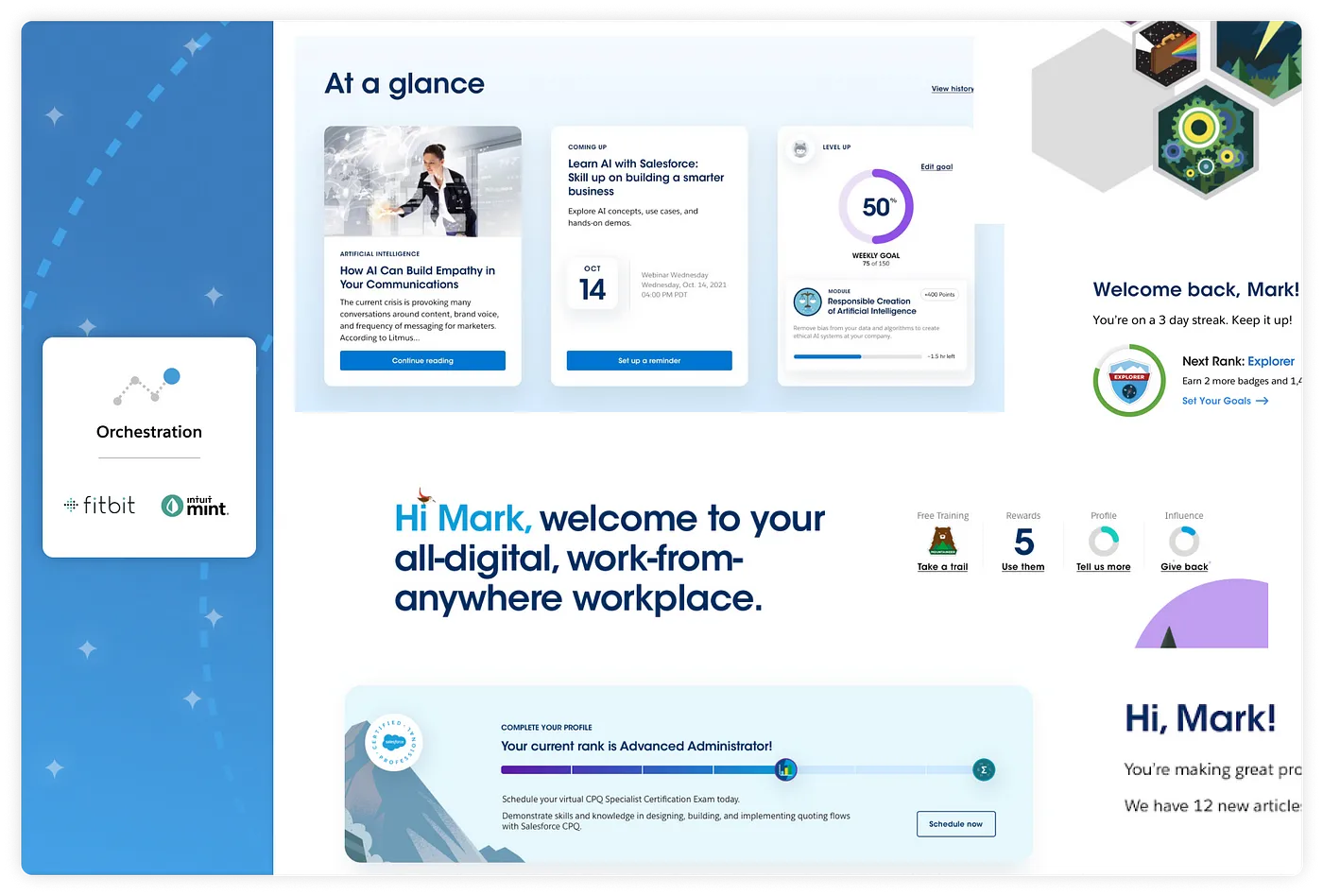
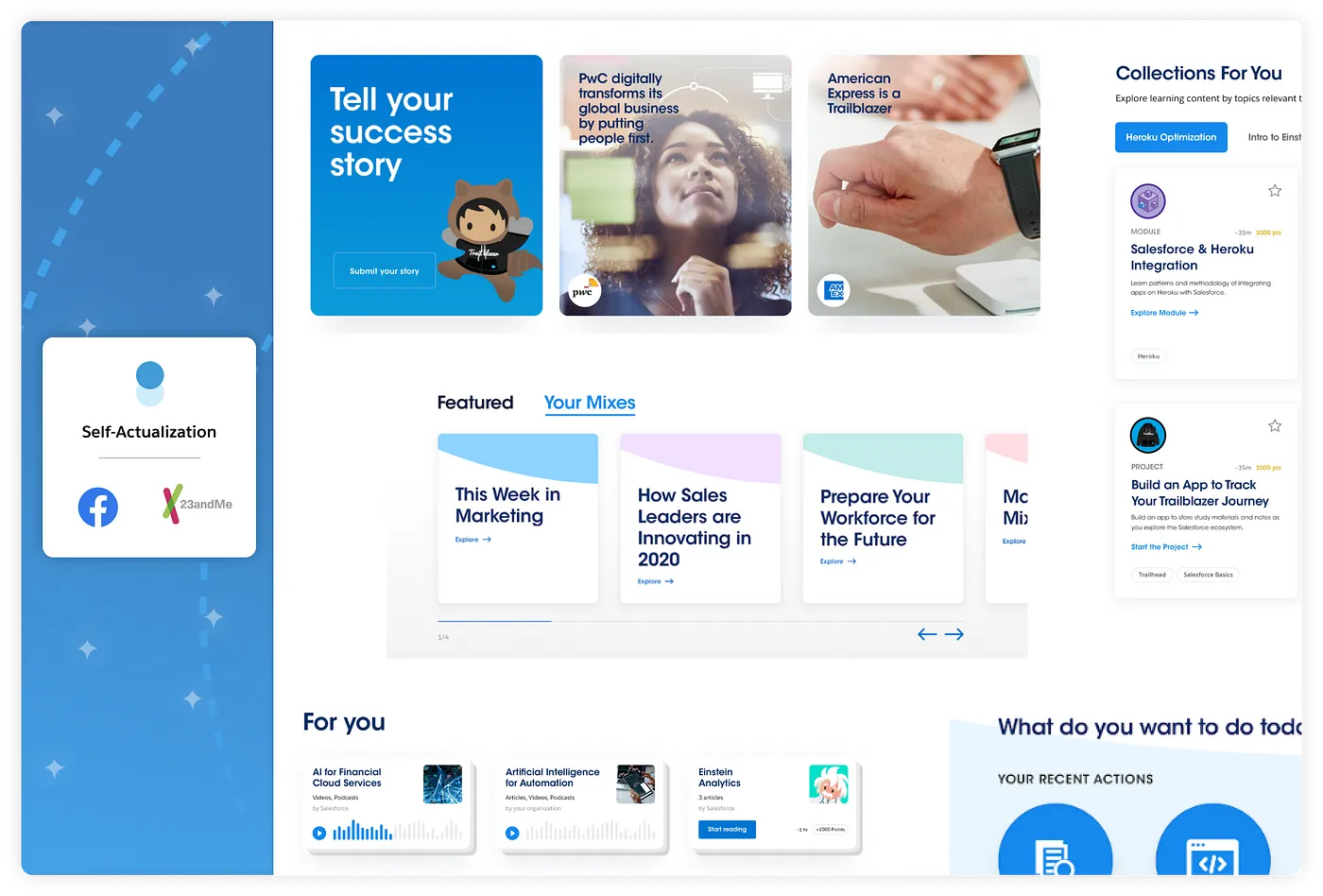
There’s no one-size fits all approach to personalization. Different products and pages must employ different methods to best leverage customer relationships in a beneficial way. The most innovative products make use of a multitude of patterns to deliver rich, highly personal content and experiences their customers love.
Learn more about the dynamic platform and personalization strategy argodesign delivered for Salesforce.


